


Inspiration is a funny
thing. What inspires and motivates me might not be what motivates my best
friend. Drake, Reid and Kolohon (2014) state
the importance of knowing your students when designing curriculum. Though, as a
future educator I will not specifically be designing my own curriculum I will be
organizing activities that must best suit my students, so I think this idea is crucial
for student learning. With that being said lessons that were taught 20 years ago
no longer suit the needs of students. What
I find to be interesting is that media and technology motivate almost everyone.
They have this unique power to engage students in subjects that could be
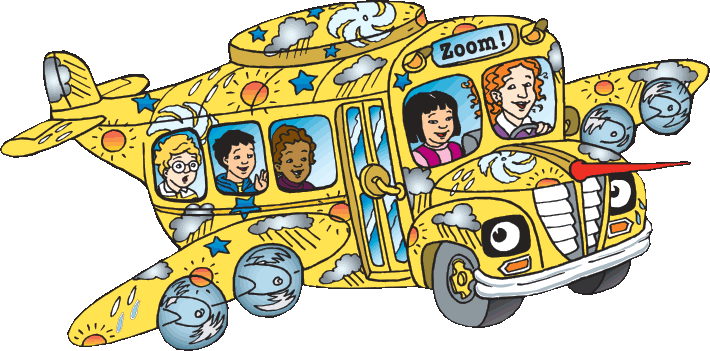
considered boring and uninteresting. Even with videos like the, Magic
School Bus; it gives students a different perspective on curriculum content.
Increasing the
use of media and technology within the schools for the most part have been seen
as a positive change for 21st learning; however, Moore, Jensen and
Hatch (2001) argue that this may not be the case as children lack crucial
critical thinking skills. Critical thinking skills are vital skills for a child’s
success within and outside of the education system. Drake, Reid ad Kolohon
(2014) explain throughout the text that almost all curriculum documents within
the education system have this as part of their mandatory skills to be learnt. I
think this is absolutely essential- students must be taught to in a sense; ‘read
in between the lines’. It is more often then not that I hear students explain
that they want to look like a cover girl or that they want the newest iphone in
grade one because it looks ‘cool’ on tv. I think these moments should be
considered ‘teachable moments’. Additionally, moments like this usually ‘spark’
interest in students and can further promote inquiry skills. Inquiry skill
development is vital component to the Ontario curriculum currently and this
form of media could be an excellent tool to scaffold that development (Ontario Ministry of Education, 2013). Specifically Clarke (2012) sheds some light on the positive aspects of utilizing technology in the classroom as she supports this notion that technology has the ability to enhance inquiry based learning. Overall it is these moments where we must teach children
that not all ‘cover girls’ have to look a certain way and that there is a tool
out there called photoshop. We must teach them to question all that they see
and hear so that they are able to make educated decisions and form educated
thoughts.

The power media
and technology have on students is astounding. Just like how Magic school bus
inspired me to want to become a doctor for a week; it is evident that media and
technology are major influencing factors on the lives of children. Popular
movies shown in class like: “Bill Nye the Science Guy” stay with students for
years and can be remembered fondly as part of their elementary school days. It
is important to note though (as mentioned above) that there is some controversy
with this kind of teaching.
This Dove beauty video is an example of media can also
be a helpful tool when it comes to teaching critical thinking skills.
Comparatively
however; in going back to the notion that technology and media may not be ‘good
for education’; YouTuber Jonathan
Stickland poses an interesting spin on technology and education in the
classroom. He explains that perhaps technology can help with learning certain
things but it’s the collaboration of hands on learning that can truly make a
difference. Do you agree?
With
that being said technology and media are apart of our daily lives and I believe
that as future educators we have a responsibility to teach our students how to
get the most of it and how to properly use it. Overall I ask myself how I can
be as motivating and inspiring as Miss Frizzle. Is it the red curly hair she
has? Or is the magic bus she drives? Or could it possibly be her cute little
green lizard, Liz? It is my quest to find the answer to that question and I
believe part of that answer by made hidden in what content we teach students
(the curriculum), the skills we teach them and the values we teach them. I
think that media and technology may be a tool like the magic school bus was for
Miss Frizzle to help inspire my students. So my quest continues to discover how
I, Miss Emma can inspire, motivate and re-define success for my students.
If you are
additionally interested in reading about the controversery between allowing technology
in the classroom the below article by Today’s Parent is an Interesting Read.
Let me know your thoughts!
An interesting Read:
References:
Clarke,
E. J. (2012). Empowering Educators through Teacher Research: Promoting
Qualitative Inquiry among K-12 Educators. Journal Of Ethnographic
& Qualitative Research, 7(2), 64-79.
Drake, S. M., Reid, J. L., & Kolohon, W. (2014). Interweaving
Curriculum and
Classroom Assessment: Engaging the
21st Century Learner. Don Mills,
ON: Oxford University Press.
Moore,
R., Jensen, M., & Hatch, J. T. (2001). Bad teaching: it's not just for the
classroom anymore. American Biology Teacher (National
Association Of Biology Teachers), 63(6), 389-391.
doi:10.1662/0002-7685(2001)063[0389:BTINJF]2.0.CO;2
Ontario Ministry of Education.
(2013). Social studies grades 1 to 6 history and geography
grades 7 to 8. In
the Ontario curriculum.
Images:
Miss Frizzle Images from: http://static.sarahbessey.com/wp-content/uploads/2014/01/3e730de6abe5ac5dddab1d6f5a0918f3.jpg
Magic School Bus Image from: http://www.baylor.edu/content/imglib/2/3/8/3/238322.gif


I really enjoyed reading your blog Emma! You made a really good point about knowing your students and how that relates to motivation. We need to constantly reinvent ourselves as teachers so that we can know our students. This means providing differentiated instruction and personalizing curriculum. Technology is again and again, proving to be an excellent tool in the educational sphere. To often is technology left on the side lines and not completely integrated into the classroom. It can be scary for teachers to incorporate technology at times when it does not work as planned. This has happened in some of my university classes, and it ends up being frustrating and takes away from the learning experience. However, teachers need to step outside of their comfort zone and expand their boundaries. We need to be student-focused not teacher-comfort-focused. What barriers are in your life that stop you from expanding the format of knowledge and using technology? For me, I need to work on being vulnerable in front of my class and being open to sharing my failure.
ReplyDeleteEmma,
ReplyDeleteGreat points on media and technology in the classroom. I think that kids today are actually different than we were when we were in school. They have grown up with technology being integrated in almost every form of their life. You had excellent personal connections, i.e. watching Miss Frizzle's episode on how Ralphie got sick and they were searching through his blood stream, and how it made you want to become a doctor, was awesome! I seriously remember this episode, as well as many other episodes of the Magic School Bus. You also integrated the Ontario Curriculum seamlessly in your blog, relating it to inquiry and critical thinking.
Furthermore, your blog was fun to read! And looks pretty :) I like how you added in the article at the end that also brings up the controversial issue about how some parents don't think technology is good in the classroom. Having both sides of the arguments is very beneficial, it lets the readers know you are not biased in your opinion.
Emma, thanks so much for the throwback to Ms. Frizzle, really took me back to my time in elementary school. This reminds me that the used of media (specifically television shows) is not a new concept to help teachers get students interested in a subject, but that is has changed drastically since I was elementary school. You really get to the point of how important it is to teach students critical thinking skills now that we use so many different forms of media to teach students. As teachers we can pre-screen the things we show to our students and discuss with them before and after to make sure they understood and meanings weren’t misconstrued but there is so much technology available that students can easily look up many different things on their own. So while technology is a great advancement it’s also a large hazard and teaching students to “read between the line” as you mentioned is really important. Awesome job showing the benefits and risks and making sure people are aware of both!
ReplyDelete