

 |
| http://www.baylor.edu/content/imglib/2/3/8/3/238322.gif |
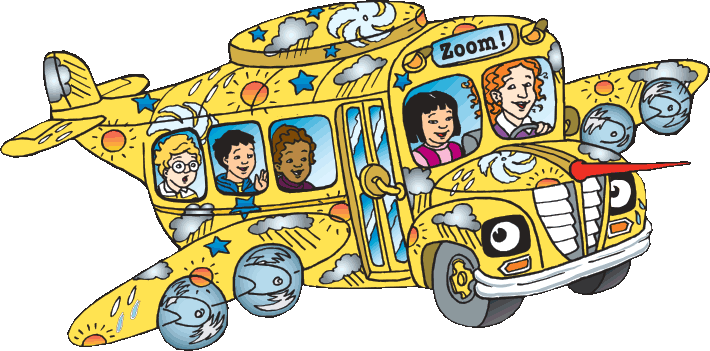
Why is the
sky blue? Why do Monkey eat bananas? Why is the earth round? Kids have
questions. These questions are what I consider to be magic! They have the power
to motivate children to learn through their skills and talents! As my quest to
become a teacher like Miss Frizzle continues I find myself exploring different
types of learning. Within the Magic School bus episodes Miss Frizzle drives her lessons on her student’s questions and interests. In the video below Miss
Frizzle's students wonder how bees make honey, whether its right to take
honey from bees and what happens in a bee hive. These questions drove her
lesson and most importantly inspired her students to get involved in their
learning. Miss Frizzle embraces a few different types of learning styles but
emphasis the importance of wonder and asking questions. This type of learning
style can be defined as Inquiry based learning.
It's absolutely amazing to be able to see how excited a child gets when you embrace their question no matter how simple or extravagant it may be. It gives them a voice and a sense of autonomy. Miss Frizzle truly embraces this notion as every student's voice is valued and they all have the opportunity to ask questions and have those questions answered. The Ontario curriculum has inquiry embedded within their documents for every subject taught to students from K- grade 12 (Ontario Ministry of Education, 2013). It’s refreshing to see this apart of the document as we begin to come away from traditional teaching that had kids confined to their seats and subject to learning in an environment they did not allow for many “wonder moments” or moments for collaboration. Drake, Reid ad Kolohon (2014) explain inquiry based learning as an opportunity for students to gain a better understanding of the world around them and allows them to problem solve in addition to thinking critically. Lisenbee, Hallman and Landry (2015) describe a very interesting teaching opportunity in geography that includes geocaching with students. Their study enabled students to get to know the community where they lived, gave them a hands on experience and ultimately motivated their learning of geography. Enabling students to become active participants in their own learning inspires them to become life long learners which is crucial for their optimal success.
Ultimately inquiry based learning and student- based inquiry gives students that “grit” or spark to learn. It helps to re-define success in terms of what we traditionally associate it to grades. Students feel successful when they have answered their questions! It allows for students of different multiple intelligences to become engaged and gain a whole new perspective of the teaching content. Alvarado and Herr (2003) notes the benefits of teaching subjects like mathematics through the inquiry based learning style. They discuss how students become active and motivated learners in subjects such as math that many would become disengaged in if their strengths did not lie in that subject. This even applies to the above Magic School Bus episode as Arnold always dreads the field trips but by the end of the episode has become engaged and excited to learn.
It’s daunting as a new teacher to be able to ensure that all students’ strengths are being highlighted. I have a fear of letting a student “slip through the cracks” and in order to combat this I truly believe that valuing my students’ voices and talents through inquiry based learning will allow my students to be successful. I want my students to feel as though their success does not evolve solely on grades. I want my students to be able to feel the power of their “wonders” or their “um moments”! My favourite memories in school were the ones where m teachers valued my questions and sought to answer them in an exciting way. I will always remember my grade three teacher, in my opinion took learning to a whole level. My twin brother had asked her one day how baby chicks communicate with one another and later that week we had eggs that were about to hatch. My grade three teacher truly embraced inquiry based learning and allowed us to be curious! TedTalks presenter, Kath Murdoch explains the power of curiosity and wonder as being vital components to education.
Therefore, I think the ultimate way to become Miss Frizzle is to
embrace my student’s voices, their questions and their strengths. I don’t think
it’s just the red hair or Friz that makes her such an exciting teacher; I think
it’s the way in which she believes in her students. So to embrace the words of
Miss Frizzle: “Take chances, make mistakes and get messy!” I will become a
teacher that does just that. I will let my students discover the world around
them by letting them ask questions, take chances and get messy!
 https://s-media-cache-ak0.pinimg.com/736x/a9/10/11/a91011d6aa10862f1c58ca8f074ab2e8.jpg
References:
Alvarado, A. E., & Herr, P. R. (2003). Inquiry-based learning using everyday objects: Hands-on instructional strategies that promote active learning in grades 3-8 Corwin Press, , A Sage Publications Company, 2455 Teller Road, Thousand Oaks, CA 91320-2218 (hardbound: ISBN-0-7619-4679-9, $61.95; paperbound: ISBN-0-7619-4680-2, $27.95). Retrieved from http://search.proquest.com/docview/62234250?accountid=9744
Lisenbee, P., Hallman, C., & Landry, D. (2015). Geocaching is catching students' attention in the classroom. Geography Teacher, 12(1), 7-16. Retrieved from http://search.proquest.com/docview/1697488121?accountid=9744
It's absolutely amazing to be able to see how excited a child gets when you embrace their question no matter how simple or extravagant it may be. It gives them a voice and a sense of autonomy. Miss Frizzle truly embraces this notion as every student's voice is valued and they all have the opportunity to ask questions and have those questions answered. The Ontario curriculum has inquiry embedded within their documents for every subject taught to students from K- grade 12 (Ontario Ministry of Education, 2013). It’s refreshing to see this apart of the document as we begin to come away from traditional teaching that had kids confined to their seats and subject to learning in an environment they did not allow for many “wonder moments” or moments for collaboration. Drake, Reid ad Kolohon (2014) explain inquiry based learning as an opportunity for students to gain a better understanding of the world around them and allows them to problem solve in addition to thinking critically. Lisenbee, Hallman and Landry (2015) describe a very interesting teaching opportunity in geography that includes geocaching with students. Their study enabled students to get to know the community where they lived, gave them a hands on experience and ultimately motivated their learning of geography. Enabling students to become active participants in their own learning inspires them to become life long learners which is crucial for their optimal success.
Ultimately inquiry based learning and student- based inquiry gives students that “grit” or spark to learn. It helps to re-define success in terms of what we traditionally associate it to grades. Students feel successful when they have answered their questions! It allows for students of different multiple intelligences to become engaged and gain a whole new perspective of the teaching content. Alvarado and Herr (2003) notes the benefits of teaching subjects like mathematics through the inquiry based learning style. They discuss how students become active and motivated learners in subjects such as math that many would become disengaged in if their strengths did not lie in that subject. This even applies to the above Magic School Bus episode as Arnold always dreads the field trips but by the end of the episode has become engaged and excited to learn.
It’s daunting as a new teacher to be able to ensure that all students’ strengths are being highlighted. I have a fear of letting a student “slip through the cracks” and in order to combat this I truly believe that valuing my students’ voices and talents through inquiry based learning will allow my students to be successful. I want my students to feel as though their success does not evolve solely on grades. I want my students to be able to feel the power of their “wonders” or their “um moments”! My favourite memories in school were the ones where m teachers valued my questions and sought to answer them in an exciting way. I will always remember my grade three teacher, in my opinion took learning to a whole level. My twin brother had asked her one day how baby chicks communicate with one another and later that week we had eggs that were about to hatch. My grade three teacher truly embraced inquiry based learning and allowed us to be curious! TedTalks presenter, Kath Murdoch explains the power of curiosity and wonder as being vital components to education.
References:
Alvarado, A. E., & Herr, P. R. (2003). Inquiry-based learning using everyday objects: Hands-on instructional strategies that promote active learning in grades 3-8 Corwin Press, , A Sage Publications Company, 2455 Teller Road, Thousand Oaks, CA 91320-2218 (hardbound: ISBN-0-7619-4679-9, $61.95; paperbound: ISBN-0-7619-4680-2, $27.95). Retrieved from http://search.proquest.com/docview/62234250?accountid=9744
Lisenbee, P., Hallman, C., & Landry, D. (2015). Geocaching is catching students' attention in the classroom. Geography Teacher, 12(1), 7-16. Retrieved from http://search.proquest.com/docview/1697488121?accountid=9744
Ontario Ministry of Education. (2013). Social studies grades 1 to 6 history and geography
grades 7 to 8. In the Ontario curriculum.

